
Home / Light source
A DWDM laser source that scales by adding lasers
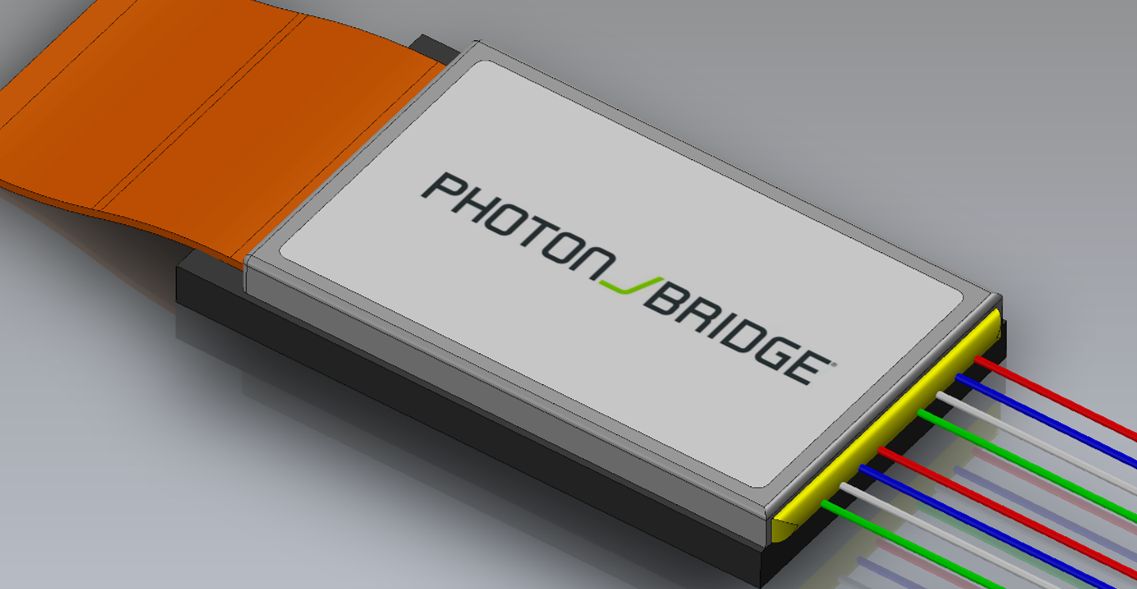
Eight DFB lasers and the wavelength multiplexer sit together on one silicon interposer. The design has a clear path to 16 and 32 wavelengths for the next generations of co-packaged optics.
What is inside
An array of distributed feedback (DFB) lasers, each tuned to its own channel, is flip-chip bonded onto a silicon interposer with thick waveguides. The multiplexer that combines the channels lives on the same silicon.
Each laser works at a modest, thermally manageable power. The combined output gives a CPO engine the multi-wavelength light it needs.
Channel count grows with the array
Conventional sources reach more channels by demanding more power from each laser die. Here the next generation simply adds lasers to the array.
Roadmap illustration. Photon Bridge states a scalable path to 8, 16 and 32 wavelengths; timing for 16 and 32 is not published.
Three ways to light a CPO engine
A summary of the trade-offs Photon Bridge describes in its DWDM whitepaper.
| Approach | How it adds channels | Where it struggles |
|---|---|---|
| Discrete DFB external laser source | Each extra colour needs a higher-power laser die to keep the same output at the CPO input. | Yield penalties compound, cost rises non-linearly and fewer suppliers can make the parts. |
| Comb laser | One source produces many lines at once. | Early stage. Wall-plug efficiency, power per line and manufacturability are still open, and low line power clashes with micro-ring modulator input needs. |
| Photon Bridge DFB array | Adds DFB lasers on the interposer, with the multiplexer integrated next to them. | Keeps the efficiency and supply chain maturity of DFB technology. Lasers can come from several qualified foundries. |
Numbers we can share today
Published by Photon Bridge. Full datasheets follow with the sample programme.
Per wavelength
Design target for optical power on each channel.
Power handling
Silicon waveguides 50x larger than usual allow more than 1 W of optical power.
Lower power density
Compared with conventional laser sources, as published by Photon Bridge.
Join the 2027 sample programme
First samples go to customers in 2027, with mass production prepared from 2028. Early partners help set wavelength plans, connectors and test flows.