
Laser light for the optical links inside AI data centres
Photon Bridge builds multi-wavelength light sources on silicon. Several modest DFB lasers, each on its own wavelength, are combined into one fibre, so the source grows with the number of channels instead of the power of a single laser.
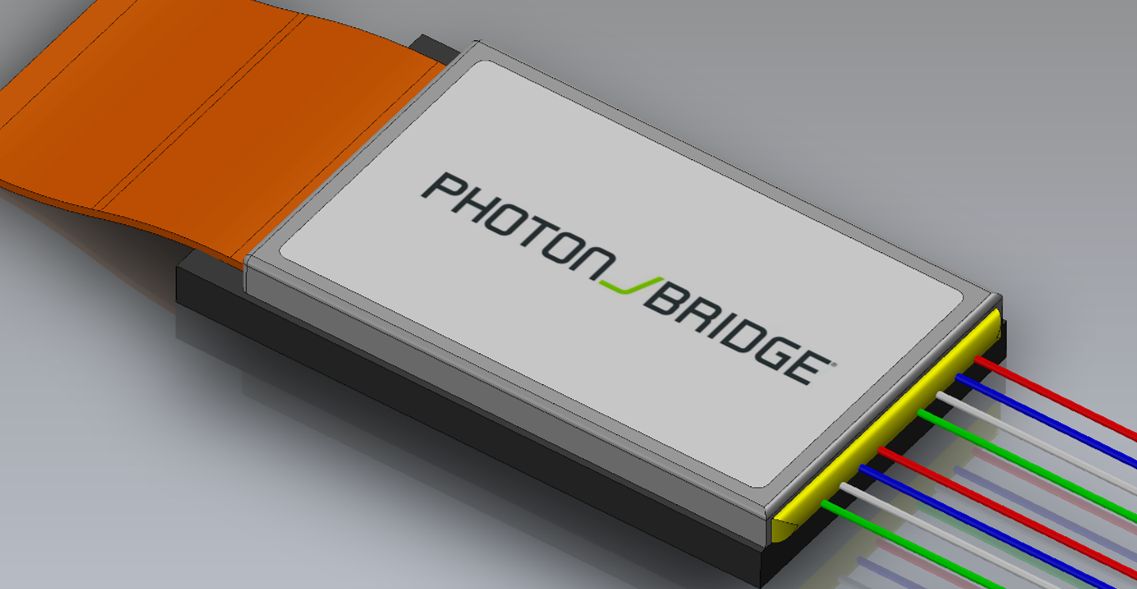
- >2x
- optical output power compared with conventional sources
- >10x
- smaller form factor
- 40 mW
- design target per wavelength
- 2027
- first customer samples, volume production from 2028
How one light source carries eight wavelengths
Scroll to take the source apart. Each step below is what happens on a Photon Bridge interposer.
Colours stand in for infrared wavelengths the eye cannot see.
One laser, more power per channel
A conventional source asks a single laser die for more power with every channel added. Yield and supplier choice shrink as that power goes up.
Eight modest DFB lasers
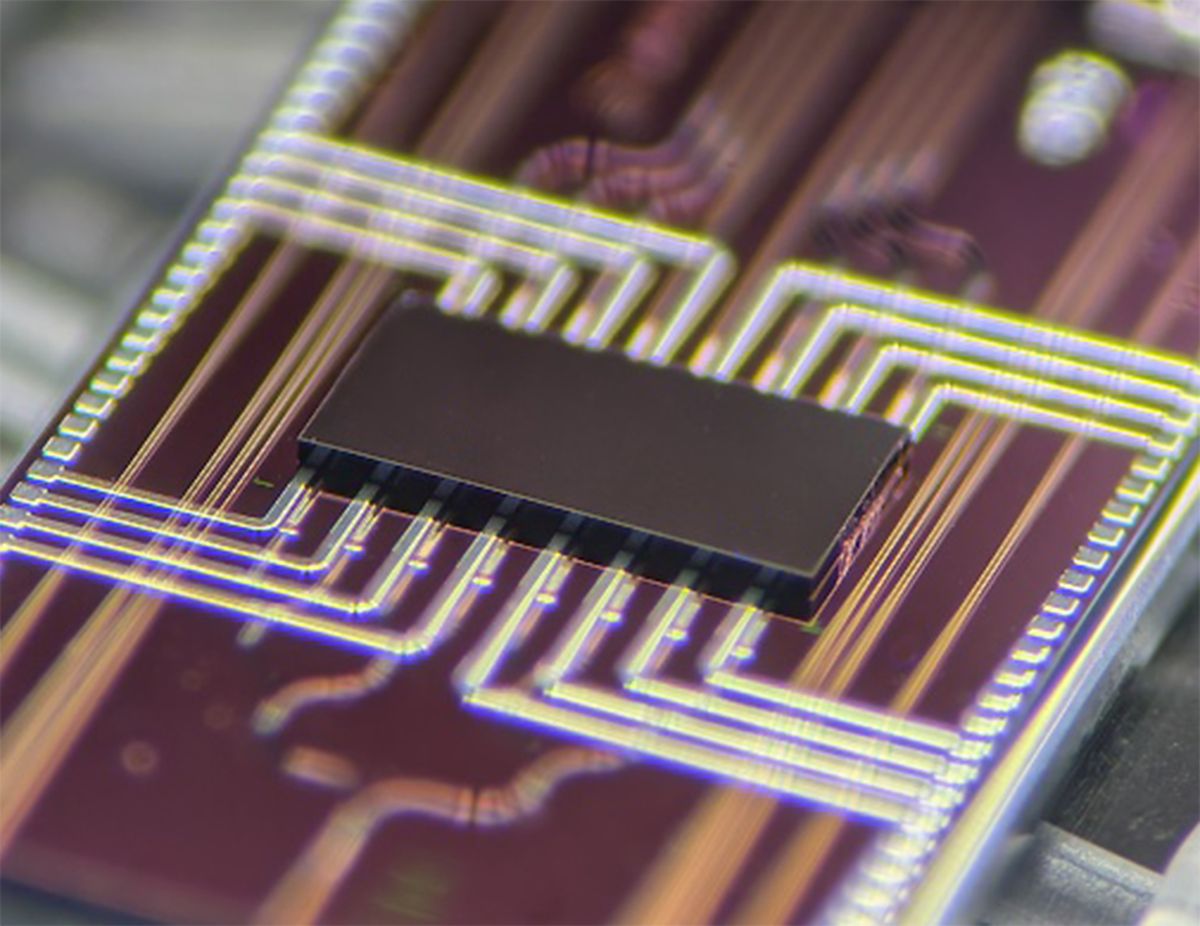
Photon Bridge places an array of DFB lasers on a silicon interposer. Each runs at a comfortable power on its own wavelength, inside the envelope of several qualified foundries.
One fibre out
A multiplexer on the same silicon combines the wavelengths into a single output fibre, ready to feed co-packaged optics. More channels means adding lasers, not pushing harder on one.
AI clusters need lasers by the million
Bandwidth inside AI data centres doubles about every two years, which pushes links beyond what copper can carry. The industry is moving to optical interconnects built on silicon photonics and co-packaged optics, and every one of those links needs a laser to supply the light.
The laser supply chain was built for telecoms, which needs far fewer of them. Photon Bridge designs its source so that it can be built in volume with outside chipmakers and standard packaging partners.
“The industry will soon need millions of these laser sources every year.”
Built in packaging lines, not wafer fabs
The cantilever platform joins III‑V lasers to thick silicon waveguides with standard flip‑chip bonding. That changes three things for anyone buying light sources.
Faster bonding
Lasers are placed with high-speed flip-chip tools at OSAT partners, with no special alignment equipment.
Alignment at the optical I/O
Accuracy holds even at fast bonding speeds, which allows any number of optical inputs and outputs per device.
Lower wavelength variation
Passive parts need little or no active tuning, so the source draws less power and needs simpler thermal control.
Where the light goes
The same platform delivers high-power, multi-colour lasers on silicon for computing and for sensing.
Co-packaged optics
Compact light sources for CPO and near-packaged optics engines that connect GPUs and switches at tens of Tbps per mm.
External laser sources
Light sources that sit outside the optical engine and feed it many wavelengths through fibre.
Lidar and spectral sensing
High-power laser integration at low manufacturing cost for sensing the physical world.
From Eindhoven lab to volume production
The October 2026 round funds product development, customer testing and hiring in Eindhoven.
- 2020Founded in Eindhoven by Rui Santos and Xaveer Leijtens
- 2025€4.75M seed as Photon IP
- Oct 2026€10M round co-led by Amadeus APEX and 360 Capital
- 2027First samples to customers
- 2028Preparing for mass production
Plan your engine around early samples
First samples ship in 2027. Tell us your wavelength count and power budget and we will tell you where Photon Bridge fits.